What Counts as an Approved Site for Your Phoenix Experience
The University of Phoenix says your in-person experience takes place in approved healthcare or practice settings, which may include your workplace or local community. That word, approved, is where a lot of students get stuck. A clinic that says yes is not automatically a site your program will accept, and a willing clinician is not automatically an approved preceptor. This page explains what an approved site actually means, what the approval usually involves, and how we prepare your site and preceptor to clear it.
Tell us your program and city. It is free to ask, with no obligation.
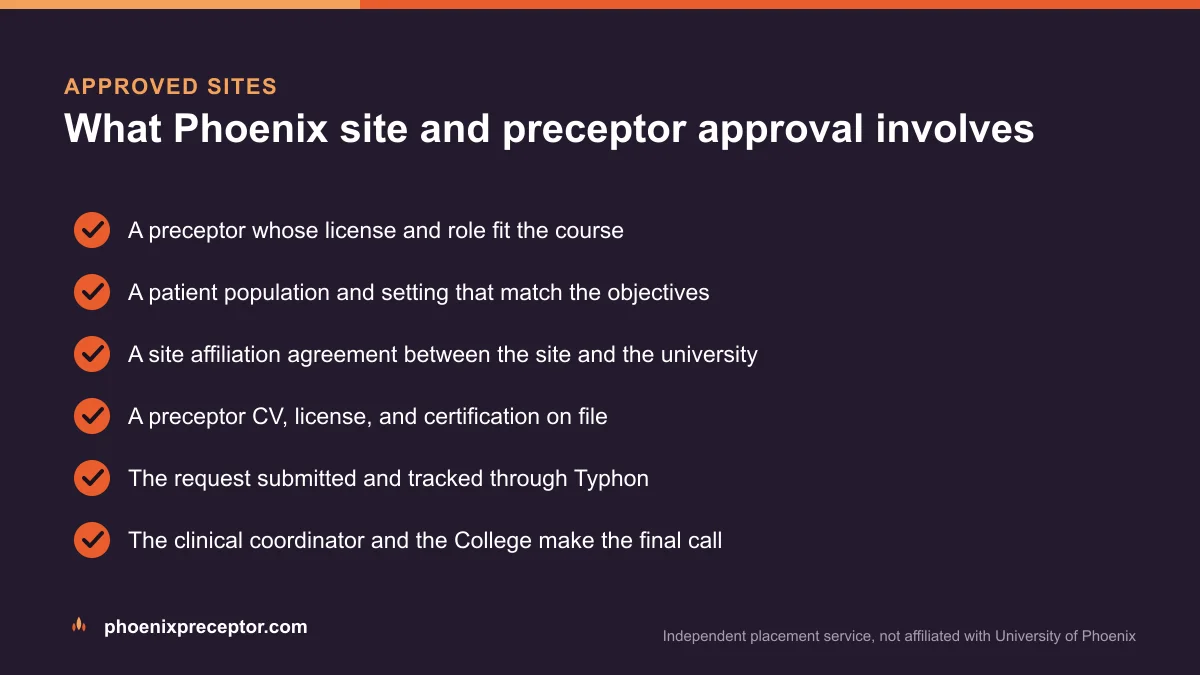
Approved is a program decision, not a handshake
The most important thing to understand is that approval is the university's call, not the site's and not yours. A practice can be delighted to host you and still fail to meet the program's requirements, because the standards are about the learning experience, the preceptor's credentials, and the paperwork, not just a willingness to have you on site.
That is why we draw a hard line between a willing site and an approved site. Willingness gets you a conversation. Approval gets you hours that count. The gap between the two, credentials, scope, documentation, and setting fit, is exactly where placements fall through when students arrange them alone, usually after they have already emotionally committed to a site.
The precise approval criteria come from your University of Phoenix Nursing Student Handbook and your program faculty, and they differ by program. Treat everything below as the general shape of approval, and confirm the specifics for your program against your handbook.
What approval usually involves
While the details vary by program, an approvable placement generally has to satisfy a few common elements. Missing any one of them is enough to hold up a placement.
- An appropriate setting. The site has to match the experience type, community or public health for RN-to-BSN, primary care for FNP, psychiatric for PMHNP, an education, leadership, or informatics setting for the non-NP MSN tracks, and a practice or project site for the DNP.
- A qualified preceptor. The supervising clinician has to hold the credentials and scope your program requires, not merely be experienced and willing.
- Documentation. Approval commonly requires the preceptor's CV and a signed preceptor or affiliation agreement so the program can verify the fit.
- Any site-level agreement. Larger organizations often require their own affiliation agreement and onboarding, which adds time to the process.
- Your own clearances. Background checks, immunization records, and similar clearances typically have to be in place before you begin.
None of these are unusual, but together they are why approval takes longer than students expect, and why starting early matters. The paperwork moves on the institution's timeline, not yours.
| Element | What it means |
|---|---|
| Appropriate setting | Matches your experience type: community health, primary care, psychiatric, education, leadership, informatics, or a DNP project site |
| Qualified preceptor | Holds the credentials and scope your program requires |
| Documentation | Preceptor CV and a signed preceptor or affiliation agreement |
| Site-level agreement | Larger organizations often require their own affiliation agreement and onboarding |
| Your clearances | Background checks, immunization records, and similar |
Why sites fall through, and how to avoid it
Placements collapse for predictable reasons, and almost all of them are avoidable with the right preparation.
The most common failure is a scope mismatch: a preceptor whose practice does not actually match your program, an FNP student placed with a preceptor who only sees adults when the track needs the full lifespan, or a PMHNP student offered a preceptor who is not credentialed for psychiatric care. Since Phoenix's NP tracks are FNP and PMHNP, the fit questions are lifespan primary care and psychiatric scope respectively, and a mismatch there means hours that do not count.
The second is documentation that arrives too late. A qualified preceptor who cannot produce a CV, or sign an agreement, before a deadline is functionally unapprovable no matter how good they are. The third is a site-level agreement that no one anticipated, common in hospital systems, which can add weeks. We plan around all three by screening for scope up front, gathering documentation early, and identifying institutional approval channels before they become a surprise.
How we get your site and preceptor approval-ready
Our job is to hand the university a placement that is easy to approve, so review is a formality rather than a hurdle. Practically, that means:
- We match the setting to your program before we approach anyone, so the fundamental fit is right.
- We screen the preceptor's credentials and scope against your program's requirements, not just their willingness.
- We assemble the documentation early, CV, agreement, and any site-level paperwork, so nothing is missing at deadline.
- We flag institutional approval channels where an organization routes placements through a central office, and work that channel deliberately.
We aim for an approvable placement, but the final decision is always the University of Phoenix's, and we do not speak for the university. We do not guarantee approval or outcomes, and nothing here is a tuition refund. If your own workplace might serve, our using your workplace guide covers that case, and how it works lays out the full process. To start, tell us your program and city on the contact page.
Good to know
What does an approved site mean at the University of Phoenix?
It means a healthcare or practice setting the university has accepted for your specific program, with a qualified preceptor and the required documentation in place. Approval is the university's decision, not the site's, so a willing clinic is not automatically approved. The exact criteria come from your Nursing Student Handbook and differ by program.
Why is a willing site not automatically approved?
Because approval is about the learning experience, the preceptor's credentials and scope, the setting fit, and the paperwork, not just a willingness to host you. A site can want you there and still fail to meet the program's requirements. Bridging that gap, and preparing the documentation, is much of what our service does.
What documentation does site approval usually need?
It commonly includes the preceptor's CV and a signed preceptor or affiliation agreement, and often a site-level affiliation agreement for larger organizations, plus your own clearances such as background checks and immunization records. Requirements vary by program; confirm yours against the Nursing Student Handbook.
How long does site approval take?
It varies, but longer than most students expect, because the paperwork and any institutional agreements move on the organization's timeline. That is why we start early and gather documentation up front. Hospital systems with central education offices tend to take the longest.
Are you affiliated with the University of Phoenix?
No. We prepare your site and preceptor to clear the university's approval; the university makes the final decision.
Keep your comeback on schedule
Tell us your program, your city, and your timeline. We will come back with a placement plan and a realistic path to an approved site and preceptor.