RN-to-BSN Practicum and Community Health Placement for Phoenix Students
The University of Phoenix RN-to-BSN is fully post-licensure and mostly online, but it is not entirely a desk program. Both the traditional and competency-based tracks build in direct-care clinical hours that must happen in the community, in person, at an approved public-health setting. That is the piece students underestimate, and it is the piece we handle. This page explains what the RN-to-BSN field experience actually requires, where those hours happen, and how we secure an approved local site and a qualified preceptor so your community-health courses run on schedule.
Tell us your program and city. It is free to ask, with no obligation.
What the RN-to-BSN clinical requirement really is
Phoenix designed the RN-to-BSN for working registered nurses, so most of the degree is asynchronous online coursework you complete around your shifts. The exception is the public-health nursing sequence, where the program requires supervised, on-site clinical hours in a community setting.
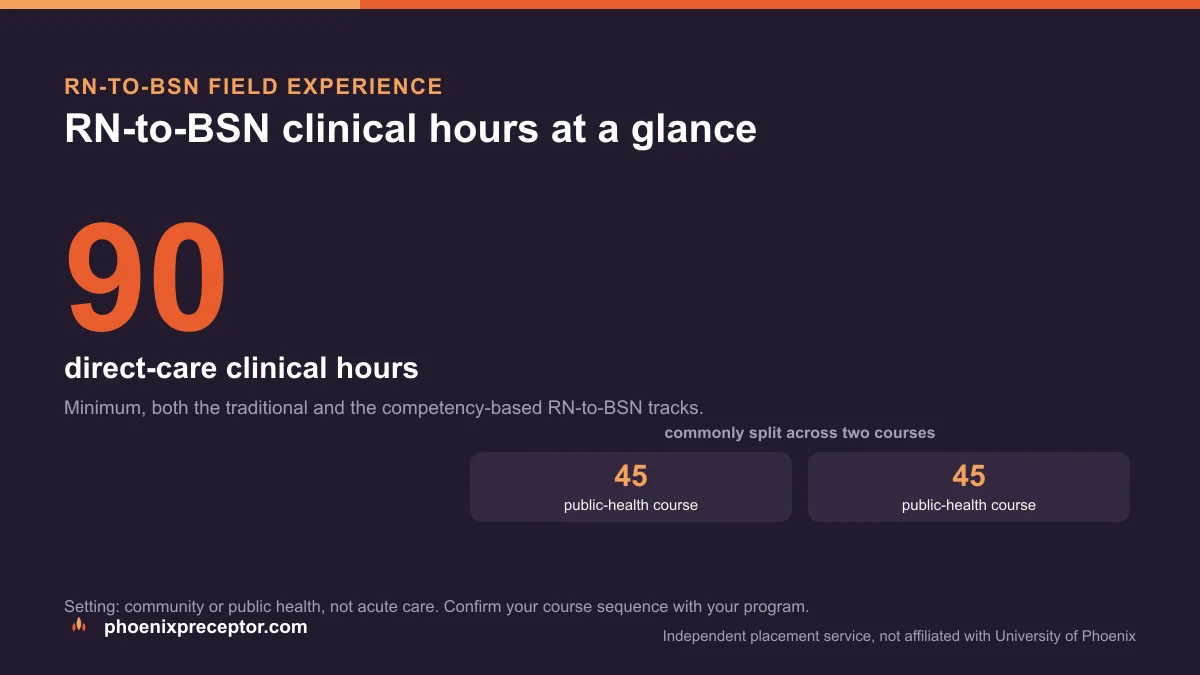
The current figure published for both the traditional and competency-based RN-to-BSN tracks is a minimum of 90 direct-care clinical hours, completed across the designated public-health nursing courses (commonly two courses at 45 hours each). A defining detail: these hours must be based in community health, not acute care. In other words, the hospital floor where you already work does not automatically satisfy them. Requirements can change, so confirm the exact hours and course structure against the University of Phoenix Nursing Student Handbook before you plan around any number.
| Element | Requirement |
|---|---|
| Direct-care clinical hours | Minimum 90, both traditional and competency-based tracks |
| Course structure | Commonly two public-health courses, about 45 hours each |
| Setting | Community and public health, not acute care |
| Multi-day Phoenix residency | None |
| Supervisor | Approved community or public-health nurse |
There is no multi-day residency in the RN-to-BSN. The in-person obligation here is the community field experience, and the challenge is location and preceptor, not travel: you need an approved community or public-health setting near you and a supervising professional the program will accept.
Why acute care does not count, and what does
This is the point that catches practicing RNs off guard. You may spend forty hours a week delivering acute care, but the RN-to-BSN public-health hours are meant to move you out of the acute setting and into population and community health. The competencies are about prevention, health promotion, and care at the community level, which is why the hours are pinned to public-health settings rather than the unit you staff.
Common approvable RN-to-BSN community and public-health settings include:
- County or city public-health departments, immunization clinics, communicable-disease and maternal-child programs
- Community health centers and FQHCs, primary and preventive care for underserved populations
- School health and student-health programs, screening, health education, and follow-up
- Home health and hospice agencies, care delivered in the community rather than the hospital
- Occupational and employee-health programs, workplace wellness and prevention
- Faith-based, shelter, and nonprofit community-health programs, outreach to specific populations
Whether a given site qualifies, and whether your own employer's community-health arm can serve, is a program decision. We match you to settings that fit the community-health intent of the requirement and prepare the site for your program's approval rather than assuming a location will pass.
Who can supervise your RN-to-BSN field experience
The RN-to-BSN field experience is supervised, and the person overseeing your community hours has to be acceptable to the program. In practice that usually means a qualified professional at the community or public-health site, frequently a BSN-prepared or higher registered nurse, a public-health nurse, or another approved preceptor whose role fits the community-health work.
Because RN-to-BSN hours are community-based rather than advanced-practice, the preceptor bar is different from the graduate NP tracks, but the site and supervisor still have to be approved, and the paperwork still has to be complete before you start logging hours. The exact eligibility rules come from your Nursing Student Handbook and your program staff. We line up a site and a supervising professional who fit those rules and get the arrangement documented so your community courses do not stall on an unconfirmed placement.
If you are weighing whether your own workplace can serve, our using your workplace guide walks through when an employer setting works and when it does not, and our approved site guide explains what approval actually involves.
How we place your RN-to-BSN community hours
Our role is to remove the one in-person obstacle in an otherwise online degree. You tell us your city and your enrollment timeline, and we source an approved community or public-health setting and a qualified supervisor near you, early enough that the placement is settled before your public-health courses begin.
- Location first. Community hours have to be local, so we search your area for public-health departments, community health centers, school-health and home-health programs, and similar approvable settings.
- Fit for the requirement. We target settings that match the community-health, non-acute intent of the RN-to-BSN field experience, so the hours you log actually count.
- Approval-ready. We help assemble what the program needs to approve the site and supervisor before you start, rather than after.
- On your timeline. We aim to have the placement in hand before the public-health nursing sequence, not during it.
Final approval of any site or supervisor rests with the University of Phoenix, not with us, and we do not speak for the university. We do not guarantee hours, grades, or program outcomes, and nothing here is a tuition refund. What we offer is a settled community placement so the field-experience piece never becomes the reason your RN-to-BSN slips a term. See how it works or start on the find a preceptor page.
Good to know
Does the University of Phoenix RN-to-BSN require clinical hours?
Yes. Both the traditional and competency-based RN-to-BSN tracks require a minimum of 90 direct-care clinical hours, completed in person during the public-health nursing courses. These hours must be based in community health, not acute care. Confirm the exact requirement against your University of Phoenix Nursing Student Handbook, since it can change.
Can I do my RN-to-BSN hours at the hospital where I work?
Not automatically. The RN-to-BSN clinical hours are specifically community-health and public-health based, not acute care, so your regular hospital unit generally will not satisfy them. A community-health arm of your employer might qualify, but that is a program decision. We help you find and secure an approved community setting when your workplace cannot serve.
Is there a residency in the RN-to-BSN program?
No. Unlike the FNP and PMHNP master's tracks, the RN-to-BSN does not include a multi-day in-person residency in Phoenix, Arizona. The in-person requirement is the community and public-health field experience, completed locally. Confirm details against the Nursing Student Handbook.
Are you affiliated with the University of Phoenix?
No. We help you find and secure an approved community site and supervisor; final approval always rests with the university.
Keep your comeback on schedule
Tell us your program, your city, and your timeline. We will come back with a placement plan and a realistic path to an approved site and preceptor.