Can You Do Your Phoenix Practicum at Your Own Workplace?
It is the first question most working nurses ask: can I just do my University of Phoenix in-person hours where I already work? Phoenix's own language leaves the door open, experiences take place in approved settings, which may include your workplace or local community, but that may is doing a lot of work. Sometimes your employer is the ideal site. Sometimes it cannot be approved, or cannot serve the requirement. This page explains when your workplace works, when it does not, and what we do when it cannot.
Tell us your program and city. It is free to ask, with no obligation.
When your workplace is a genuine advantage
For some programs, using your own employer is not just allowed, it is often the strongest option. You already know the system, the people, and the workflows, which removes a lot of friction from onboarding and, for project-based work, gives you real access to stakeholders.
This is most true for the DNP, where the Applied Project is a practice-change or quality-improvement initiative that frequently fits best inside an organization you already understand. It can also work for the non-NP MSN concentrations, Nurse Education, Nurse Administration, and Informatics, where a practicum in your own department, with a qualified educator, leader, or informatics preceptor, maps naturally to your role.
Even in the best case, though, using your workplace is still subject to approval. The setting has to fit the requirement, the preceptor or mentor has to be qualified and approved, and the arrangement has to be documented. Employer plus willing supervisor is a strong start, not a done deal.
| Program | Workplace often fits? | Why |
|---|---|---|
| DNP Applied Project | Often yes | Practice-change project fits an organization you already know |
| MSN non-NP (Education, Administration, Informatics) | Often yes | Practicum can map to your own department with a qualified preceptor |
| RN-to-BSN | Usually not if acute | Hours must be community or public health, not acute care |
| MSN FNP | Only with an in-scope preceptor on site | Needs a board-certified FNP or in-scope primary-care physician |
| MSN PMHNP | Only with an in-scope preceptor on site | Needs a board-certified PMHNP or psychiatrist |
When your workplace does not qualify
Just as often, your day job is the wrong site, and it is worth knowing why before you count on it.
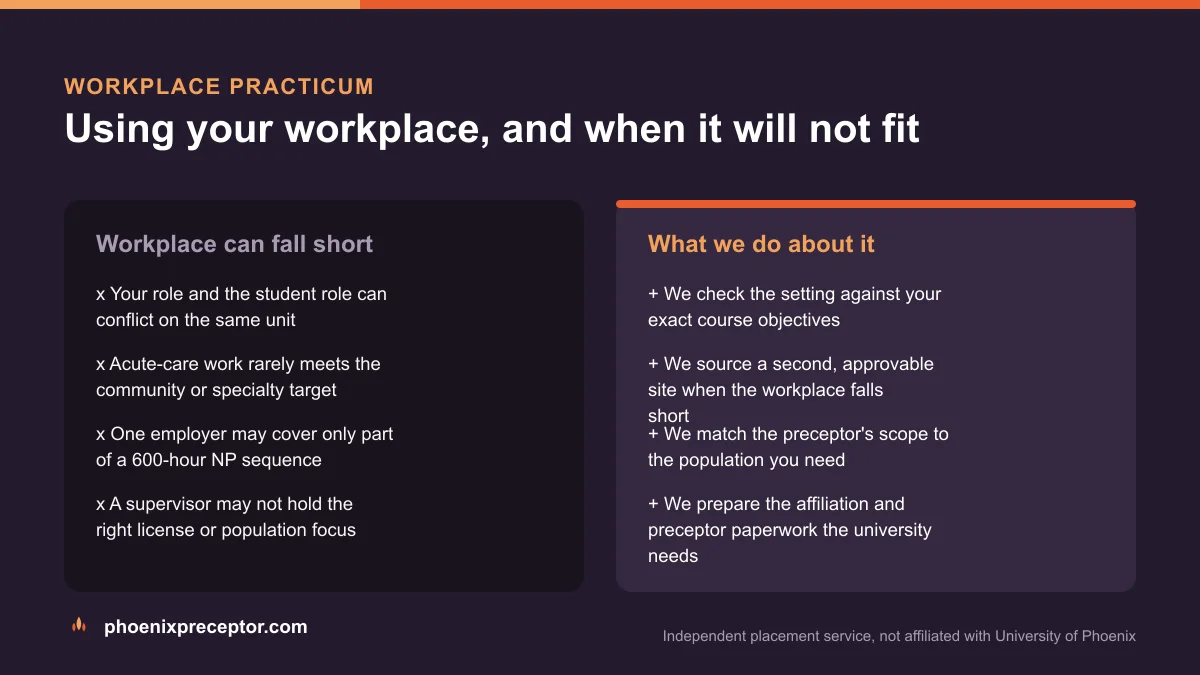
- RN-to-BSN, wrong care setting. The RN-to-BSN clinical hours are community-health and public-health based, explicitly not acute care. If you work an acute hospital unit, that unit generally will not satisfy the requirement, even though it is your workplace. You need a community setting.
- FNP and PMHNP, scope and supervision. The NP tracks need a preceptor with the right advanced-practice scope, a board-certified FNP or in-scope primary-care physician for FNP, a board-certified PMHNP or psychiatrist for PMHNP, supervising you in the right setting. If your workplace lacks a qualified preceptor in that scope, or the setting does not fit, it cannot serve, no matter how convenient it is.
- No qualified preceptor on staff. Even in the right setting, if no one on site holds the credentials and scope your program requires, and can commit to supervising you, the site does not work.
- Employer or policy limits. Some employers decline to host students, restrict supervising staff, or cannot sign the required agreements. That is common and outside your control.
Whether your specific workplace qualifies is a program decision governed by your Nursing Student Handbook, not something we or anyone else can promise in advance. The approved site guide explains the approval criteria in more detail.
The conflict-of-role problem
There is a subtler reason a workplace placement can be discouraged even when the setting and a preceptor technically fit: role conflict. Programs are often cautious about a student being supervised by their own manager, or logging learning hours during paid working time doing their regular job, because the point of the experience is new, supervised learning, not repackaging your existing duties.
That does not rule out a workplace placement, but it does mean the arrangement has to be structured carefully: a preceptor who is not simply your boss, hours that are genuinely educational rather than your normal shift, and a clear separation between your job and your practicum. When we help evaluate a workplace option, this is one of the things we look at, so you do not build a plan the program later declines on role-conflict grounds.
What we do when your workplace cannot serve
If your employer works, great, we will help you structure and document it so it clears approval cleanly. If it does not, that is exactly the situation our service was built for. We source an approved alternative site and a qualified preceptor in your community, so a workplace that cannot serve never becomes the reason your program stalls.
- We assess your workplace honestly first, setting fit, preceptor scope, role-conflict risk, so you are not counting on a site that will not clear.
- We source a local alternative matched to your program when your workplace cannot serve.
- We handle the approval prep, credentials, documentation, and any site agreement, for whichever site you end up using.
Final approval always rests with the University of Phoenix, and we do not speak for the university. We do not guarantee that any particular workplace or alternative site will be approved, and nothing here is a tuition refund. See how it works, or tell us your program and city on the contact page.
Good to know
Can I do my Phoenix practicum at my own workplace?
Sometimes. Phoenix says experiences take place in approved settings, which may include your workplace or local community, so your employer can qualify, but it is subject to approval and does not always fit. It works best for the DNP Applied Project and the non-NP MSN practica; it often does not work for RN-to-BSN acute units or NP tracks without a qualified in-scope preceptor on site. Whether your workplace qualifies is a program decision.
Why might my hospital unit not count for RN-to-BSN?
Because the RN-to-BSN clinical hours are specifically community-health and public-health based, not acute care. Your regular acute hospital unit generally will not satisfy them even though it is your workplace. You need a community or public-health setting, which we can help you find.
Can my manager be my preceptor?
Often programs are cautious about role conflict, being supervised by your own manager, or logging learning hours during your normal paid shift. A workplace placement usually has to be structured so the preceptor is not simply your boss and the hours are genuinely educational. We look at this when we evaluate a workplace option so the plan is not declined later.
What happens if my workplace cannot be my site?
That is what our service is for. We source an approved alternative site and a qualified preceptor in your community, matched to your program, and handle the approval prep, so a workplace that cannot serve does not stall your program.
Are you affiliated with the University of Phoenix?
No. Whether your workplace or any alternative qualifies is the university's decision; we help you prepare and secure the placement.
Keep your comeback on schedule
Tell us your program, your city, and your timeline. We will come back with a placement plan and a realistic path to an approved site and preceptor.