How Phoenix NP Clinical Placement Works in Arizona
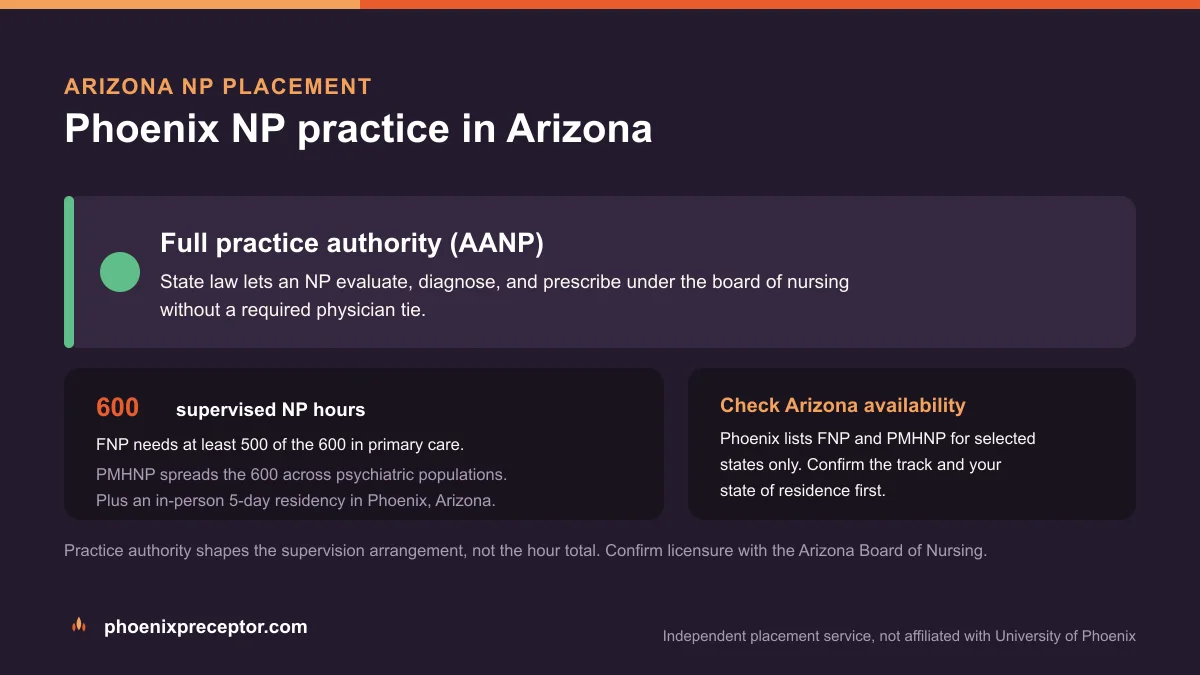
Arizona is a Full Practice state, and University of Phoenix currently lists Arizona for both its online MSN/FNP and MSN/PMH programs. The University's current licensure page also identifies both programs as approved by the Arizona State Board of Nursing.
Tell us your program and city. It is free to ask, with no obligation.
Separate state approval from placement approval
Arizona's program status gives eligible Phoenix students a clear starting point, but it does not preapprove a particular clinic. The Arizona State Board of Nursing oversees nursing licenses and approved APRN programs. The University still reviews every clinical site, preceptor, patient population, agreement, and clearance file before a student begins hours.
AANP's Full Practice category means Arizona law allows qualified NPs to evaluate patients, diagnose, order and interpret tests, and initiate and manage treatment under the state board's licensure authority. Students do not practice independently. They work under an approved preceptor, within their completed coursework, course objectives, and the site's policies.
Read the FNP hour map course by course
University of Phoenix requires at least 600 supervised clinical hours for the MSN/FNP. Adult and geriatric management I and II, women's health, and pediatrics each require 45 hours. NRP/590 carries 420 hours. At least 500 hours must be primary care, and the remaining 100 must comply with the handbook's specific primary-care and specialty limits.
Phoenix, Scottsdale, Tempe, Mesa, Chandler, and Glendale offer a dense clinical market, but demand does not make every practice appropriate. Tucson, Flagstaff, Prescott, Yuma, and Sierra Vista can open other possibilities. Start with the course population, confirm weekly patient access, and check that the preceptor can supervise the complete proposed schedule.
Treat PMH populations as separate capacity needs
The MSN/PMH requires at least 600 supervised hours. The first three clinical courses carry 60 hours each, and PMH/506 carries 420. The final portfolio must include at least 100 psychotherapy hours, 100 pediatric or adolescent hours, 100 adult hours, 100 geriatric hours, and 200 hours in any age group or a combination.
A behavioral health organization may serve adults well but have little child, geriatric, or psychotherapy volume. Ask for actual population access rather than relying on a broad service description. The preceptor must be an appropriately qualified psychiatrist or psychiatric NP under the current handbook, with limited course-specific flexibility only when the clinical coordinator confirms it.
Know who does what in the placement process
The University does not frame placement as a student-only task. Students are encouraged to network, suggest their workplace or professional contacts, and communicate with the assigned clinical coordinator. The coordinator assists in securing sites and preceptors, manages agreements and approvals, and follows up when a student lacks an approved placement. An assignment process exists, but a particular start date is not guaranteed.
A promising lead should be sent through the formal workflow. Before clinical activity begins, the site and preceptor must be approved in Typhon and the required affiliation and clearance steps must be complete. Students enter schedules, time logs, and case logs in Typhon. Preceptors verify hours, and faculty perform the final academic review.
The five-day residency is a separate requirement
Both the FNP and PMH programs include an in-person five-day residency in Phoenix, Arizona, near the end of NRP/571. Students complete faculty-supervised assessment and procedural competency checks before moving into precepted clinical courses. Living in Arizona may simplify travel, but the campus residency is not the same as a community clinical placement.
Simulation appears in the coursework, yet it does not replace the 600 supervised hours. Build the timeline around both obligations: the NRP/571 residency and the later approved clinical rotations. A placement expected to start immediately after residency should reach the coordinator early enough for contracts, credential checks, and site onboarding.
Use telehealth only within the written limits
FNP students may complete up to 100 telehealth hours, only in NRP/590. PMH students may complete up to 100 telehealth hours, and those hours should not all be concentrated in one focus area. For both pathways, the student must be physically in the same location as the preceptor while the patient encounter uses telehealth.
That structure can support a telehealth-capable Arizona placement, but it is not a remote preceptor arrangement. Confirm the course, patient population, site permission, and coordinator approval before counting virtual encounters. Our virtual placement guide keeps physical and permitted telehealth-capable options distinct.
Phoenix offers other field-based nursing work
RN-to-BSN students complete 90 direct-care hours, divided into two 45-hour community and public-health courses. The work is on-site and not acute care, with no more than four direct telehealth hours. DNP learners complete an Applied Project connected to a minimum of 1,000 total practice hours, although approved prior hours can reduce what remains.
A DNP learner selects a practice site and site-based External Consultant, then works with an assigned Project Chair. Non-NP MSN practicum hours vary by concentration and program version. For any route, use the current academic plan and approved-site guide before assuming an Arizona employer or community organization will qualify.
Get a placement plan built around your course
Send your program, course, city, dates, and patient-population needs through a free placement review. We can assess an in-person search or a permitted telehealth-capable setting, prepare a realistic radius, and organize approval information. You pay only when matched. Pricing is kept on the cost page, and no specific clinician, approval date, or outcome is promised.
Trusted by nursing students and working nurses.
Good to know
Are both Phoenix NP programs available to Arizona residents?
Yes. The current University pages list Arizona for the online MSN/FNP and MSN/PMH programs, and the licensure page identifies both as approved by the Arizona Board.
How many hours does each Phoenix NP program require?
Each requires a minimum of 600 supervised clinical hours, with different course and population distributions for FNP and PMH.
Can an Arizona student complete all NP hours by telehealth?
No. Each program allows at most 100 telehealth hours under its course rules, and the student must be physically co-located with the preceptor.
Does the University help when a student has no approved placement?
The handbook describes coordinator assistance, repeated outreach, and collaboration with the Program Chair. It also describes an assignment process, but does not promise placement by a specific date.
Keep your comeback on schedule
Tell us your program, your city, and your timeline. We will come back with a placement plan and a realistic path to an approved site and preceptor.
Trusted by nursing students and working nurses.