Planning Phoenix NP Clinical Hours Across Arkansas
Arkansas is a Reduced Practice state, and University of Phoenix currently lists Arkansas for both its online MSN/FNP and MSN/PMH programs. Eligible students can plan clinicals there, but the site, preceptor, documents, and patient mix must be approved before hours begin.
Tell us your program and city. It is free to ask, with no obligation.
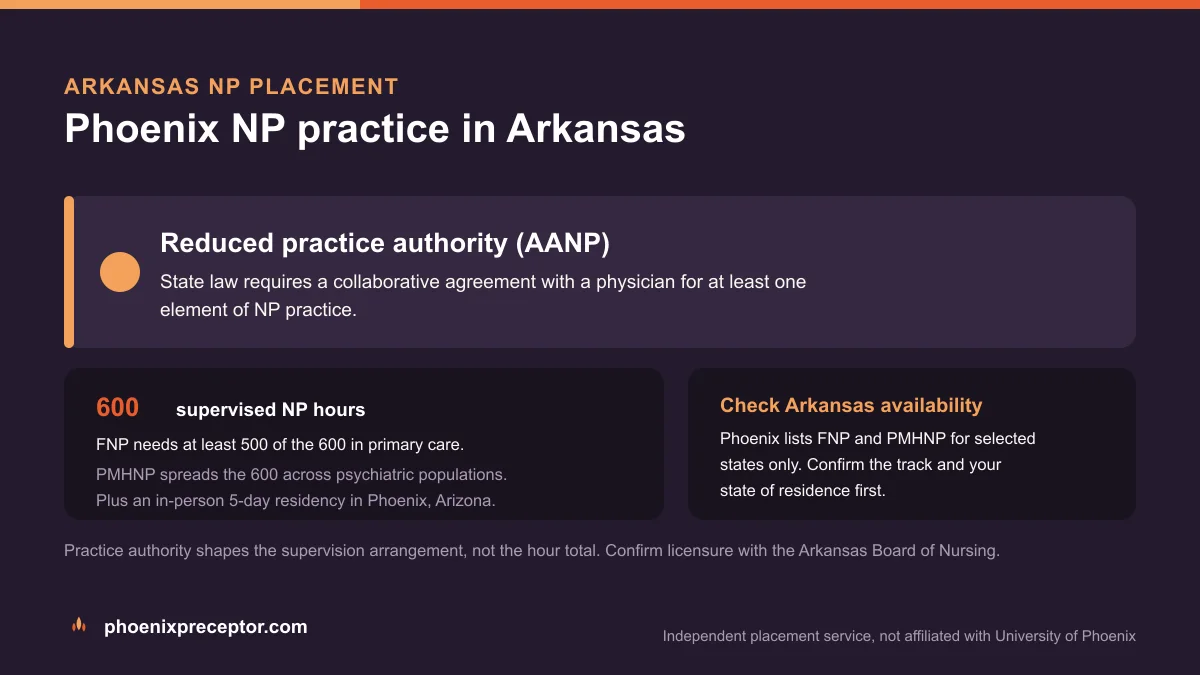
Reduced Practice shapes the setting, not the hour total
AANP's Reduced Practice label means Arkansas law limits at least one element of NP practice through a required regulated collaborative arrangement or another restriction. That affects how clinics organize care and how a proposed preceptor practices. It does not change the University's minimum of 600 supervised clinical hours for either NP pathway.
Check licensure through the Arkansas State Board of Nursing. Match the legal name and license to the clinician's CV, confirm national certification and population focus, and identify the practice location. The University evaluates the educational placement, while the Board remains the authority for Arkansas nursing credentials and practice.
Design the FNP sequence before contacting practices
Phoenix divides the FNP requirement across five clinical courses. Adult and geriatric management I and II, women's health, and pediatric and adolescent management each carry 45 hours. The final preceptorship requires 420, producing a minimum total of 600. At least 500 hours must be in primary care, with the remaining 100 governed by specific handbook limits.
A Little Rock primary-care practice may cover broad adult needs but not deliver enough pediatric or women's health encounters. Northwest Arkansas, including Fayetteville, Springdale, Rogers, and Bentonville, may offer a different mix. Fort Smith, Jonesboro, Conway, Pine Bluff, and Hot Springs can extend the radius. Evaluate each course population separately before assuming one site can support the sequence.
Audit PMH population access early
Phoenix PMH students need 600 supervised hours: 60 in psychotherapy, 60 in adult and geriatric management, 60 in child and adolescent management, and 420 in care across the life span. The program-wide minimums are 100 psychotherapy, 100 pediatric or adolescent, 100 adult, 100 geriatric, and 200 hours in any age grouping or mix.
Ask behavioral health sites for concrete age distribution and psychotherapy exposure. An outpatient practice with high volume may still be a poor match if the needed focus is missing. The proposed preceptor must meet the handbook's psychiatry qualifications, and the site must allow the supervision, case logging, and faculty evaluation required by the course.
Placement is a working partnership
University of Phoenix encourages students to bring professional contacts and possible workplace leads to the clinical coordinator. The coordinator assists in securing a site and preceptor, manages approval and contracting work, and maintains scheduled touch points as the first clinical course approaches. Students remain responsible for responding, completing compliance items, and communicating changes.
If an approved site is still missing, the handbook describes collaboration among the coordinator, Program Chair, and student and an assignment process within 100 miles of residence. The University does not promise that assignment by a specific date. That makes early planning useful even when the student expects University help.
Do not work ahead of Typhon approval
Typhon is the clinical system for the NP placement record. The site and preceptor must be approved there, and the required affiliation agreement and clearance work must be finished before clinical activity starts. During the rotation, students enter schedules, clinical time, and patient case information. Preceptors verify records, and faculty approve the academic documentation.
An Arkansas clinic's informal yes is useful, but it is not permission to begin. Confirm who can sign for the organization, whether an agreement already exists, and whether the site has extra screening requirements. Use the approved-site guide to organize those questions before submitting a lead.
Account for Phoenix residency and format rules
Both NP tracks require a five-day in-person residency in Phoenix, Arizona, near the end of Advanced Health Assessment II and Clinical Procedures. Students complete faculty-supervised competency checks before entering precepted courses. The Arkansas placement cannot substitute for this campus requirement, even if the preceptor offers skills training locally.
Only final-preceptorship FNP work may include up to 100 telehealth hours in Arkansas. PMH permits up to 100 telehealth hours across its rules, without placing all of them in one focus area. In both, the student must be physically with the preceptor. We can review physical and telehealth-capable Arkansas options, but a fully remote clinical claim would be inaccurate.
Keep other Phoenix programs in their own lanes
RN-to-BSN learners complete 90 direct-care community-health hours, 45 in each of two public-health courses. The experience is on-site and not acute care, with no more than four direct telehealth hours. DNP learners complete an Applied Project tied to a minimum of 1,000 total practice hours and may receive University approval for qualifying prior hours.
DNP students select a practice site and External Consultant and work with an assigned Project Chair. Non-NP MSN requirements depend on concentration and program version. Confirm Arkansas availability and the current academic plan before starting any of these searches.
Move from course data to a qualified match
Use a free placement review to share your course, Arkansas city, dates, population requirements, and any existing lead. We can assess an in-person or permitted telehealth-capable plan and prepare a match for University review. You pay only when matched. See the cost page for pricing. We cannot promise a specific start date or University decision.
Trusted by nursing students and working nurses.
Good to know
Are Phoenix FNP and PMH programs listed in Arkansas?
Yes. Arkansas appears on the University's current online availability lists for both NP programs. The individual site and preceptor still require approval.
Does Reduced Practice prevent an Arkansas clinical placement?
No. It describes state practice limits for licensed NPs. An eligible student may pursue an approved Arkansas placement that follows Board, University, course, and site requirements.
Who helps find the Arkansas preceptor?
The current handbook describes a partnership. Students share leads and communicate with the clinical coordinator, who assists with securing and approving sites and preceptors.
May Arkansas NP students count telehealth encounters?
Potentially, within the program's 100-hour cap and course rules. The student must be physically co-located with the approved preceptor, and the University must approve the plan.
Keep your comeback on schedule
Tell us your program, your city, and your timeline. We will come back with a placement plan and a realistic path to an approved site and preceptor.
Trusted by nursing students and working nurses.