A Careful Phoenix Clinical Plan for California Students
California is a Restricted Practice state, and University of Phoenix does not currently list California among the states where its online MSN/FNP or MSN/PMH programs meet educational requirements. Do not seek a California NP preceptor unless the University provides current written direction for your exact program, residence, and clinical state.
Tell us your program and city. It is free to ask, with no obligation.
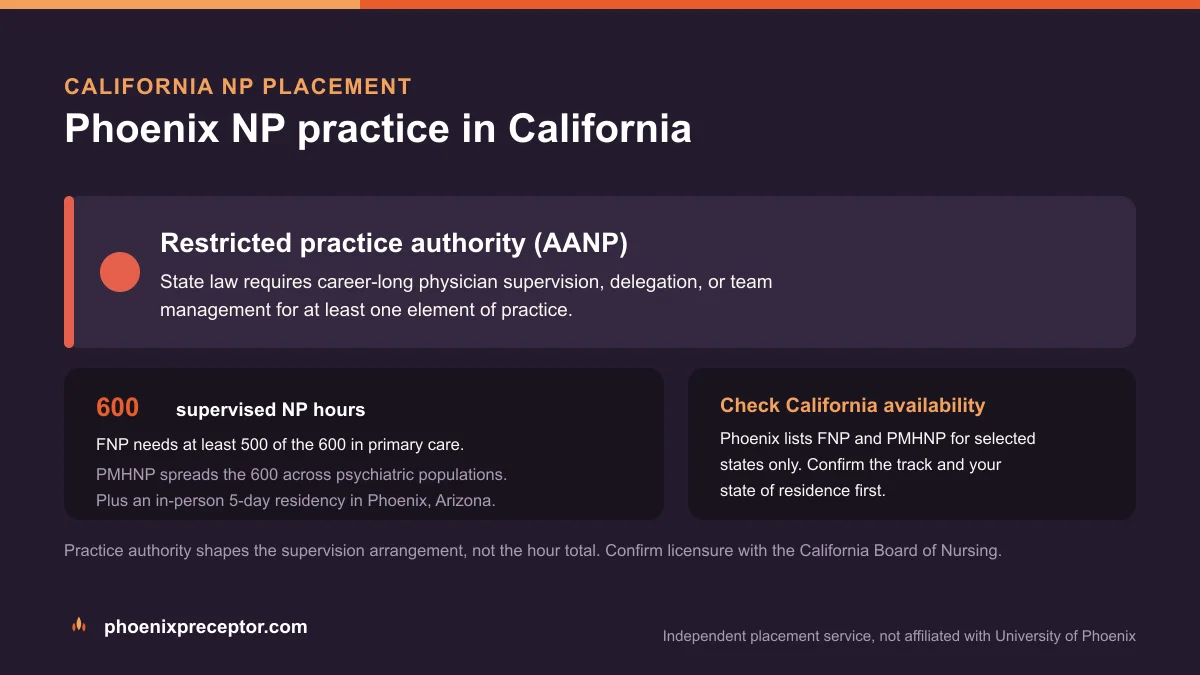
The availability answer comes before the market search
California has many clinicians and health systems, but market size does not change the University's published NP availability. A student should not contact Los Angeles, San Diego, Bay Area, or Sacramento practices for a Phoenix NP rotation based only on a course date. First obtain a written University answer tied to the current catalog and the student's state details.
If the answer does not authorize California clinical education, stop. Do not reserve a preceptor, pay for sourcing, or ask a site to begin an agreement. A legacy program reference, a clinician's prior student experience, or a general statement that classes are online is not a substitute for current program-specific direction.
Understand Restricted Practice without overreading it
AANP classifies California as Restricted Practice. In that framework, state law restricts at least one element of NP practice and requires career-long supervision, delegation, or team management by another health provider. This category speaks to licensed practice. It neither authorizes nor bars a particular school's educational program by itself.
The California Board of Registered Nursing is the official starting point for RN and advanced practice credentials. If written University direction ever supports a proposed NP experience, verify the clinician's license, certification, population focus, and site role. The University must also confirm that California practice arrangements and its course standards are satisfied.
Use current Phoenix facts when asking for direction
The FNP and PMH pathways each require at least 600 supervised clinical hours and a five-day in-person residency in Phoenix, Arizona. FNP distributes the hours across four 45-hour population courses and a 420-hour final preceptorship. PMH uses three 60-hour courses and a 420-hour across-the-life-span course, with defined psychotherapy and age-group minimums.
Include those program details in the eligibility question so the response addresses the actual clinical route. Ask whether the student's enrolled version can place hours in California, whether the University has any additional state conditions, and whether written approval is required before a coordinator will review a site.
California may fit a different Phoenix pathway
The NP availability issue should not be copied onto every nursing program. Phoenix RN-to-BSN learners complete 90 direct-care hours in community and public-health settings, 45 hours in each of two courses. The experience is on-site, not acute care, and ordinary paid work does not count. Confirm current California availability and the applicable California course version with the University.
DNP learners work toward a minimum of 1,000 total practice hours while developing an Applied Project. Approved prior qualifying hours can reduce what remains. The student selects a practice site and External Consultant and works with a Project Chair. Non-NP MSN hours vary by concentration and program version, so the academic plan controls.
A coordinator is part of the placement process
University of Phoenix describes a cooperative process rather than leaving students entirely alone. For clinical programs, students are encouraged to share professional contacts and potential workplace sites. The program or clinical coordinator assists in securing sites and preceptors, manages approvals and agreements, and follows up when an approved placement remains unresolved.
When a California experience is authorized, send any lead to the coordinator before promising dates. Typhon is used for site and preceptor approval and for the applicable clinical records. Required documents and agreements must be complete before hours begin. A clinic's willingness is helpful, but only the University's formal process makes the experience eligible for academic review.
Do not turn limited telehealth into a remote promise
The current handbook permits limited telehealth within defined pathways. RN-to-BSN direct contact may include no more than four telehealth hours. In FNP and PMH, up to 100 of the 600 hours may use telehealth under course-specific rules, and the student must be physically in the same location as the preceptor.
Those limits do not make California eligible for the online NP programs. If current written direction authorizes another Phoenix clinical experience in California, we can assess physical and telehealth-capable options within the specific rules. We will not describe a clinical as fully virtual or imply that remote hours are automatically accepted.
If authorized, search by region and patient fit
California planning should account for travel time as much as straight-line distance. Los Angeles and Orange County may offer many organizations but difficult cross-city commutes. San Diego, Sacramento, Fresno, Bakersfield, Riverside and San Bernardino, San Jose, Oakland, and surrounding communities create different patient and scheduling patterns. Set a weekly travel boundary before a site is proposed.
For any authorized pathway, match the organization's services to the course. Community health, a DNP project setting, and an NP population rotation are not interchangeable. The find-a-preceptor guide can help organize a search after written eligibility is in hand.
Review the file before sourcing starts
With current written University direction, request a free placement review. We will examine program, course, city, physical or permitted telehealth-capable format, and approval needs before accepting a California search. You pay only when matched, and the cost page owns pricing. We do not guarantee a particular site, start date, University approval, or outcome.
Trusted by nursing students and working nurses.
Good to know
Does Phoenix currently list California for FNP or PMH?
No. California is not on the current online availability list for either NP pathway. Do not begin sourcing without written University direction specific to the student.
Does California's Restricted Practice category decide school eligibility?
No. It describes the legal practice environment for licensed NPs. University program availability is a separate educational determination.
Could a California Phoenix RN-to-BSN student need a preceptor?
Potentially, if the University confirms current program availability and approves the plan. The requirement is 90 on-site community-health hours, not acute-care work.
Can telehealth make a California NP placement acceptable?
No. Telehealth rules do not override state availability. Even in eligible states, NP telehealth is capped and requires the student to be physically with the preceptor.
Keep your comeback on schedule
Tell us your program, your city, and your timeline. We will come back with a placement plan and a realistic path to an approved site and preceptor.
Trusted by nursing students and working nurses.