Matching Phoenix Clinical Requirements to Colorado Sites
Colorado is a Full Practice state, and University of Phoenix currently lists Colorado for both its online MSN/FNP and MSN/PMH programs. A Colorado rotation still requires the right population, an approved clinician, a compliant site, and completed University documentation.
Tell us your program and city. It is free to ask, with no obligation.
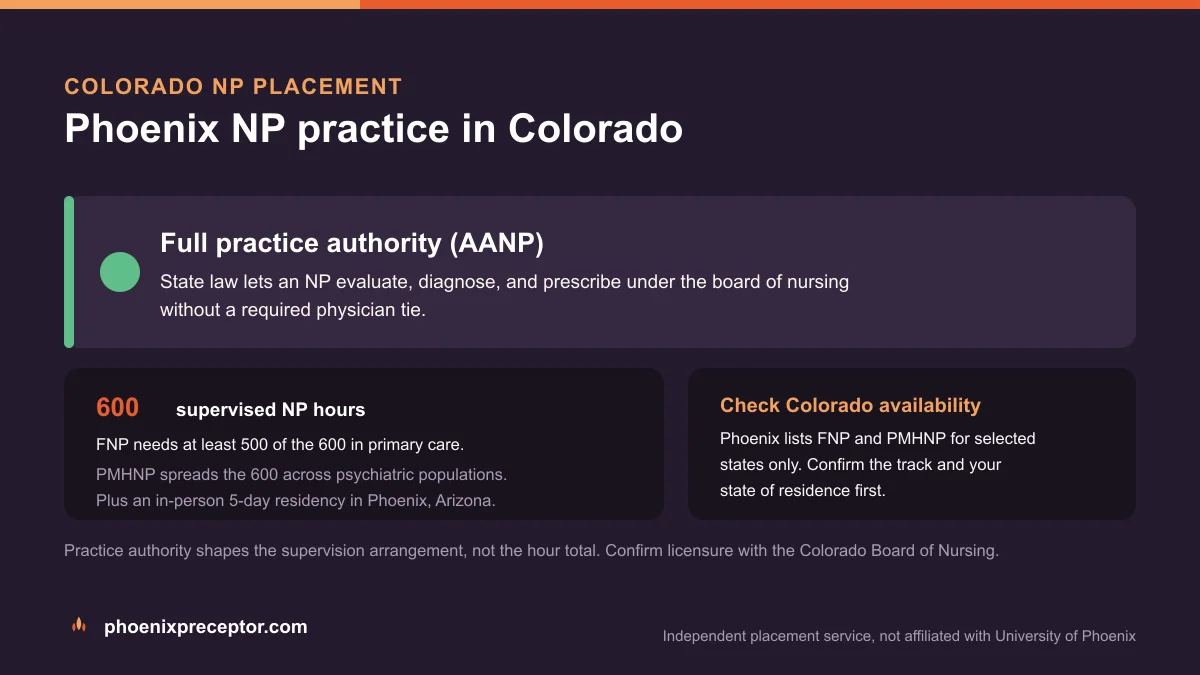
Full Practice is the regulatory backdrop
AANP's Full Practice classification means Colorado law permits qualified NPs to evaluate, diagnose, order and interpret diagnostic tests, and initiate and manage treatments under the state nursing board's authority. That can make NP roles broad in day-to-day care. A student, however, remains supervised by the approved preceptor and limited to the course and demonstrated competencies.
Use the Colorado Board of Nursing to verify a proposed clinician. Review the legal name, active and unencumbered license, advanced practice authority, national certification when applicable, and any public discipline. Then compare the practice's patient population and the clinician's experience to the specific Phoenix course.
Choose a Colorado radius that works every week
Denver, Aurora, Lakewood, and the broader metro area can provide many leads, but traffic and schedule density matter. Colorado Springs and Pueblo form another corridor. Fort Collins, Loveland, and Greeley may support northern searches, while Grand Junction and Western Slope communities require a different travel plan. Measure the commute against every clinical day, not a single visit.
Clinic type also matters. FNP primary care, women's health, pediatrics, and final-preceptorship needs may not align at one location. PMH students must protect psychotherapy and age-group coverage. Start with course objectives and patient access, then assess location.
FNP hours have a defined architecture
The Phoenix MSN/FNP requires a minimum of 600 supervised clinical hours. NRP/555 and NRP/556 each require 45 adult and geriatric hours. Women's health and pediatric management also carry 45 hours each. NRP/590, the final preceptorship, requires 420. The program requires at least 500 primary-care hours.
The remaining 100 hours are not an unrestricted specialty block. The handbook identifies allowable primary-care and specialty categories, observation limits, and course conditions. Confirm the planned service line with the clinical coordinator before a Colorado specialist is approached or an existing lead is treated as a fit.
PMH placement quality depends on distribution
Phoenix PMH students also complete at least 600 supervised hours. Three focused courses require 60 hours each, followed by 420 hours in Psychiatric Mental Healthcare Across the Life Span. The aggregate must include 100 psychotherapy hours and 100 hours in each pediatric or adolescent, adult, and geriatric group, plus 200 hours in any combination.
A Colorado site serving one dominant population may cover a course but leave a later gap. Ask for expected patient ages, encounter type, psychotherapy opportunity, preceptor availability, and supervision format. The clinical coordinator must approve the clinician and site, and the course population must match the student's current enrollment.
Follow the coordinator and Typhon sequence
Phoenix asks students to participate actively by networking, forwarding leads, and maintaining contact. The clinical coordinator assists with finding and securing placements, evaluates leads, manages affiliation requirements, and follows unresolved cases. If a placement remains missing, the handbook describes collaboration with the Program Chair and a possible assignment, but does not promise timing for a chosen start date.
Before the first shift, an affiliation agreement must be in place and the site and preceptor must be approved through Typhon. Students then enter the clinical schedule, time logs, and case logs. The preceptor verifies hours and faculty approves the record. Starting before approval can leave otherwise valid work ineligible to count.
Residency and telehealth solve different needs
The FNP and PMH programs each require an in-person five-day residency in Phoenix, Arizona, near the end of NRP/571. This is where faculty assesses clinical and procedural skills before precepted rotations. An approved Colorado site does not replace the trip, and the residency itself does not satisfy the 600 supervised placement hours.
Telehealth is limited. FNP allows up to 100 hours only in NRP/590. PMH allows up to 100, spread appropriately across focus areas. The student must be physically co-located with the preceptor in both programs. A telehealth-capable site may be useful, but a from-home or remote-preceptor promise is not supported.
Do not overlook RN-to-BSN and DNP requirements
Phoenix RN-to-BSN students complete two 45-hour public-health clinical courses for 90 direct-care hours. The settings are community based and on-site, not acute care. No more than four direct clinical hours may be telehealth. An employer might qualify only if the work is distinct from paid duties and the University approves the structure.
DNP students work toward a minimum of 1,000 total practice hours with an Applied Project. Prior qualifying hours may be awarded after review, up to the University's maximum. The learner selects a Colorado practice site and External Consultant and works with a Project Chair. Non-NP MSN requirements should be read from the current academic plan because versions differ.
Get a course-specific Colorado review
Request a free placement review with the course, location, dates, population, and any clinic lead. We can assess a physical or permitted telehealth-capable option, screen the match, and organize information for University review. You pay only when matched. The cost page contains pricing. We do not guarantee a particular clinician, approval, or start date.
Trusted by nursing students and working nurses.
Good to know
Does Phoenix list Colorado for FNP and PMH?
Yes. Colorado appears on the current online availability lists for both NP programs. Each student's site, preceptor, and documentation still need University approval.
Can one Colorado site cover all 600 FNP hours?
Possibly, but only if it provides every required population and course experience and the University approves it. Many students need more than one clinical arrangement.
Is the Phoenix residency optional for Colorado students?
No. Both NP pathways require the five-day in-person residency in Phoenix, Arizona, before precepted clinical courses.
Can a Colorado workplace serve as a clinical site?
It may be proposed, but ordinary paid duties do not count automatically. The course activities, site, preceptor, agreement, and schedule must receive University approval.
Keep your comeback on schedule
Tell us your program, your city, and your timeline. We will come back with a placement plan and a realistic path to an approved site and preceptor.
Trusted by nursing students and working nurses.