Building a Phoenix Clinical Placement Plan in Hawaii
Hawaii is a Full Practice state, and University of Phoenix currently lists Hawaii for both its online MSN/FNP and MSN/PMH programs. Island location, patient population, preceptor availability, and University approval should be planned together well before the clinical course.
Tell us your program and city. It is free to ask, with no obligation.
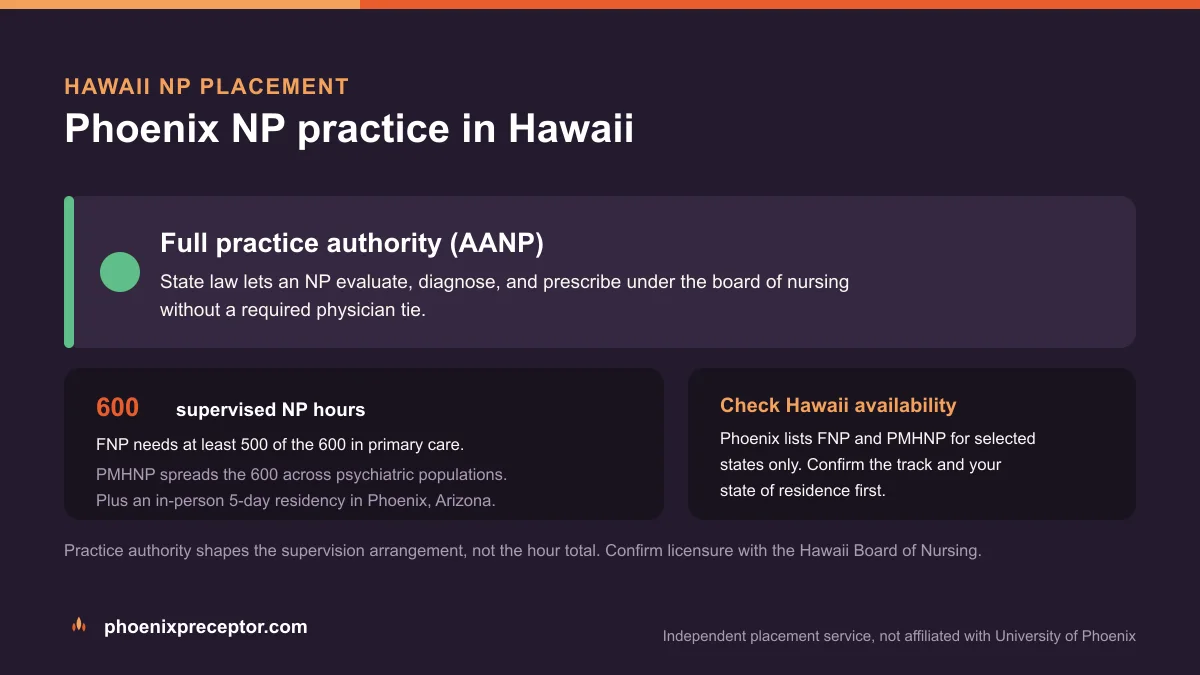
Full Practice supports broad NP roles
AANP's Full Practice category means Hawaii law allows qualified NPs to evaluate, diagnose, order and interpret tests, and initiate and manage treatments under the state board's licensure authority. Students can learn in practices where NPs hold broad responsibilities, but they do not step into independent practice during a rotation.
Check credentials through the Hawaii Board of Nursing. Confirm the proposed preceptor's legal name, current license, certification, population focus, and practice location. Phoenix separately evaluates the clinician's qualifications, the site's services, the course fit, and required agreements.
Island logistics belong in the first conversation
Honolulu and the wider Oahu market may provide the largest pool, but a student on Hawaii Island, Maui, Kauai, or another island needs a local plan or realistic travel arrangement. Interisland travel is not a dependable substitute for a stable weekly schedule unless dates, cost, lodging, and backup days are considered from the outset.
Ask the site about actual patient mix and preceptor presence, not just organizational services. A health system may offer a specialty somewhere in its network while the proposed clinic lacks that population. Record the exact address, department, clinician, schedule, and course coverage before submission.
FNP placement may require more than one setting
Phoenix FNP students complete at least 600 supervised hours. Adult and geriatric management I and II, women's health, and pediatrics each require 45 hours. The final preceptorship requires 420. At least 500 hours must be primary care, while the remaining 100 must fit detailed primary-care and specialty limits in the handbook.
A broad family practice can be valuable, but it may not provide enough pediatric or women's health encounters for a particular course. On a smaller island, identify possible population gaps early and discuss them with the clinical coordinator. A lead should be matched to the immediate course and to the larger sequence.
PMH requires planned age and psychotherapy access
The PMH program also requires at least 600 supervised hours. Three 60-hour courses cover psychotherapy, adult and geriatric management, and children and adolescents. PMH/506 supplies 420 hours across the life span. The total includes at least 100 hours each in psychotherapy, pediatric or adolescent, adult, and geriatric care, plus 200 flexible age-group hours.
A site that mainly provides adult medication management may not satisfy psychotherapy or child exposure. Ask about encounter type, age distribution, diagnostic work, and the approved preceptor's schedule. If the site cannot cover the current focus, it should not be used simply because alternatives are scarce.
Phoenix coordinates and approves the placement
The handbook describes an ongoing partnership. Students are encouraged to bring local professional contacts, including potential workplace settings, to the clinical coordinator. The coordinator helps secure sites and preceptors, manages agreements, and maintains scheduled contact. Students must complete compliance tasks and communicate promptly.
If no site is approved as the course approaches, the coordinator and Program Chair work with the student, and the handbook describes an assignment process within 100 miles of residence. In Hawaii, geography can limit what that radius contains, and the University does not promise a placement by a specific date. Early planning is especially important.
Approval and logging run through Typhon
Before clinical activity, the site and preceptor must be approved in Typhon and the affiliation and clearance file must be complete. Students enter schedules, case information, and time logs during the rotation. The preceptor verifies clinical records, and faculty reviews them for course completion.
Do not count hours from an informal shadow day or begin because a clinician has agreed verbally. A Hawaii organization may also have its own onboarding, health, privacy, or background requirements. Those site conditions are added to, not substituted for, University requirements.
Plan the Arizona residency and telehealth limits
Both NP tracks require a five-day in-person residency in Phoenix, Arizona, near the end of NRP/571. Hawaii students should budget time for travel and attendance separately from their local placement. The residency covers faculty-supervised competency checks and does not replace any part of the 600-hour precepted sequence.
FNP may use up to 100 telehealth hours only in NRP/590. PMH may use up to 100, distributed across focus areas. The student must be physically co-located with the preceptor. A Hawaii telehealth-capable site can help with patient access, but it cannot become a from-home clinical or remove the need for an approved physical site.
Consider the other Phoenix field requirements
RN-to-BSN students complete 90 on-site community and public-health hours, 45 in each course, with no more than four direct telehealth hours. DNP students develop an Applied Project and meet at least 1,000 total practice hours. Approved prior qualifying hours may reduce what remains.
DNP learners choose a practice site and External Consultant and work with an assigned Project Chair. Non-NP MSN practicum requirements vary by concentration and version. Confirm Hawaii program availability and the current academic plan for each route.
Review an island-specific search
Submit your island, course, dates, patient needs, and any local lead for a free placement review. We can assess an in-person or permitted telehealth-capable site and prepare a match for University evaluation. You pay only when matched. Pricing is shown on the cost page. We cannot guarantee a specific site, approval date, or outcome.
Trusted by nursing students and working nurses.
Good to know
Does Phoenix list Hawaii for FNP and PMH?
Yes. Hawaii is currently on both online NP availability lists. The student's island site and preceptor still need University approval.
Can Hawaii students avoid the Phoenix residency?
No. Both NP programs require the five-day in-person residency in Phoenix, Arizona, before precepted clinical courses.
Can telehealth solve an interisland placement gap?
It may support up to 100 approved hours in either NP program, but the student must be physically with the preceptor and every course and site rule must be met.
Will Phoenix help if a Hawaii student has no placement?
The handbook describes coordinator assistance, ongoing student communication, and an assignment process, but it does not guarantee a specific start date.
Keep your comeback on schedule
Tell us your program, your city, and your timeline. We will come back with a placement plan and a realistic path to an approved site and preceptor.
Trusted by nursing students and working nurses.