Start With Eligibility for Phoenix Clinicals in Louisiana
Louisiana is a Reduced Practice state, and University of Phoenix does not currently list Louisiana for either its online MSN/FNP or MSN/PMH program. Obtain current written University direction for the student's exact program and proposed clinical state before starting an NP preceptor search.
Tell us your program and city. It is free to ask, with no obligation.
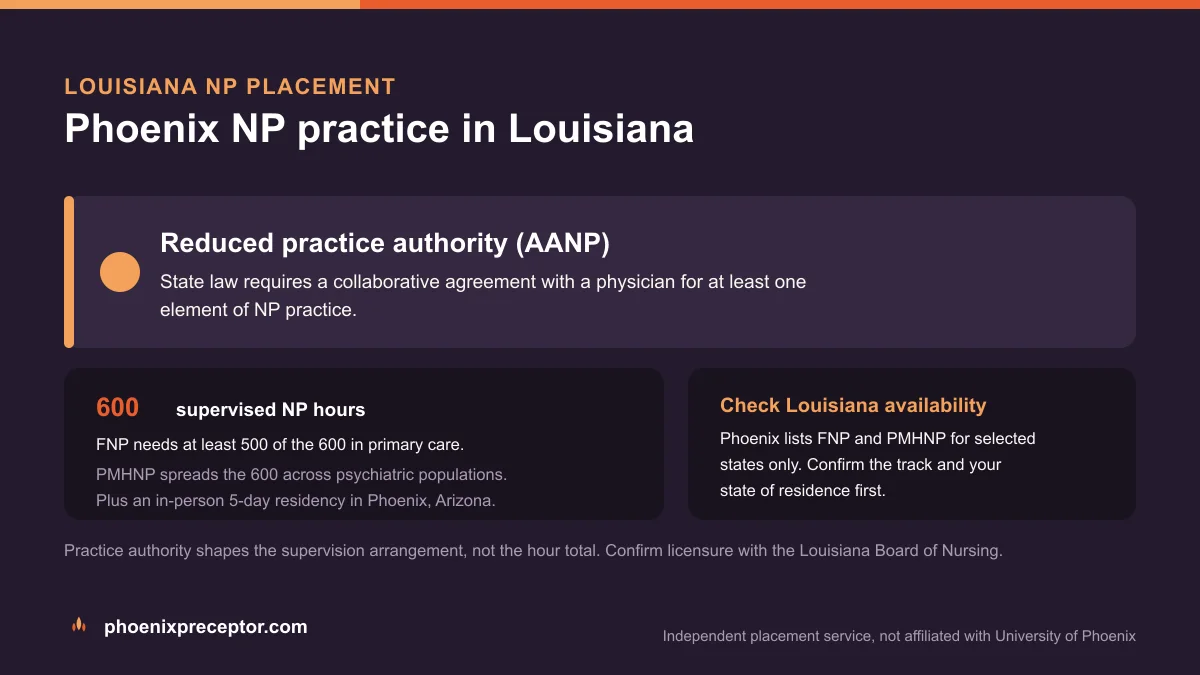
Written University direction comes before a search
The current Phoenix FNP and PMH pages do not list Louisiana as an available state. Do not infer permission from online coursework or local preceptor interest. Get written University guidance for the student's exact program version, home state, and proposed Louisiana experience before contacting sites.
Keep the response with the academic plan and clinical correspondence. If the University does not support a Louisiana NP experience, stop the search. If written direction does support it, the proposed organization, preceptor, schedule, agreement, and patient mix still require review before clinical hours can start in Louisiana.
What the AANP category means on the ground
Louisiana is classified by AANP as a Reduced Practice state. The category describes the legal environment for licensed NPs, not University program availability in Louisiana. Reduced Practice means state law limits at least one element of NP practice and requires a regulated collaborative arrangement for part of care or practice.
Use the Louisiana State Board of Nursing as the official licensing source. If Phoenix authorizes a plan, confirm the clinician's legal name, active credential, advanced practice standing, certification, population focus, and any public restrictions in Louisiana. Board standing and University educational approval answer different questions, and both matter in Louisiana.
Put the actual NP hour map in every inquiry
Phoenix FNP requires at least 600 supervised clinical hours. Adult and geriatric management I, adult and geriatric management II, women's health, and pediatric management each require 45 hours in Louisiana. The final preceptorship requires 420 hours. At least 500 hours must be primary care, so a specialty-heavy lead cannot automatically carry the entire final course in Louisiana.
Phoenix PMH also requires at least 600 supervised hours: 60 hours in each of PMH/503, PMH/504, and PMH/505, followed by 420 hours in PMH/506 in Louisiana. The full sequence must include 100 psychotherapy hours, 100 pediatric or adolescent hours, 100 adult hours, 100 geriatric hours, and 200 hours from any age group or combination in Louisiana. These facts help the University assess a proposed plan, but they do not override Louisiana's absence from the current availability lists.
Account for the Phoenix residency
Both NP programs include a five-day, in-person residency in Phoenix, Arizona, near the end of NRP/571 in Louisiana. Faculty-supervised competency work occurs before the precepted courses. The residency is separate from state clinical hours and is one reason the programs should not be described as entirely online in Louisiana.
A student asking about Louisiana should include the residency and projected clinical sequence in the timeline. Travel for the residency, compliance documents, site contracting, preceptor review, and course registration can each affect readiness in Louisiana. A clinician's start date is only one calendar factor for Louisiana.
Know how placement support and approval work
The handbook describes a partnership. Students may provide workplace contacts or professional leads, while the clinical coordinator helps locate and secure sites and preceptors, evaluates referrals, manages agreements, and communicates as clinical courses approach in Louisiana. When a placement remains unresolved, the coordinator and Program Chair work with the student and may use an assignment process within 100 miles of the student's residence in Louisiana. No particular timing is promised.
Typhon is used for site and preceptor approval, schedules, time logs, case logs, and evaluations in Louisiana. The applicable agreement and clearance file must be complete before hours begin in Louisiana. Preceptors verify clinical time, and faculty approves academic records. None of these workflow steps should begin with a Louisiana NP lead until the availability question has a written University answer.
Other nursing pathways require their own review
The Phoenix RN-to-BSN includes 90 direct-care hours in community and public-health settings, split into two 45-hour courses in Louisiana. The work is on-site, cannot simply repeat acute-care employment duties, and permits no more than four direct telehealth hours in Louisiana. Students must verify current state and program availability as well as the proposed Louisiana site.
DNP learners complete an Applied Project connected to a minimum of 1,000 total practice hours in Louisiana. Approved prior graduate practice hours may count, up to 500, so the remaining total differs by student in Louisiana. The learner selects a practice site and External Consultant and works with a Project Chair in Louisiana. Non-NP MSN practicum requirements depend on the concentration and catalog version in Louisiana.
Virtual contact does not bypass state eligibility
Only final-preceptorship FNP work may include up to 100 telehealth hours in Louisiana. PMH permits up to 100 telehealth hours, with distribution across focus areas rather than concentration in only one in Louisiana. For both programs, the student must be physically in the same location as the approved preceptor while the patient participates remotely in Louisiana.
Those limited options do not turn an ineligible state into an eligible one and do not support a fully remote placement in Louisiana. If Phoenix supplies written authority for a Louisiana experience, consider physical sites and telehealth-capable sites only within the course, organization, state, and University rules.
Match the radius to the weekly schedule
New Orleans, Baton Rouge, Shreveport, Lafayette, Lake Charles, and Monroe represent different recruiting and travel markets. Compare the student's actual starting point with traffic, weather, shift length, weekly frequency, and total course weeks in Louisiana. A distant site can appear workable for one visit but become unreliable over a full rotation in Louisiana.
Course fit should narrow the region before a directory search. Primary care, psychiatric age groups, psychotherapy, community public health, and an evidence-based DNP project each point toward different organizations in Louisiana. Record patient access, preceptor presence, expected dates, and the authorized contract contact for any lead the University permits in Louisiana.
Request help only after written authorization
When current written University direction supports the proposed Louisiana experience, submit a free placement review. We will review the course, location, patient needs, schedule, and physical or permitted telehealth-capable format before sourcing in Louisiana. You pay only when matched. Pricing appears only on the cost page. We do not promise University approval, a particular clinician, timing, or academic results in Louisiana.
Trusted by nursing students and working nurses.
Good to know
Does Phoenix currently list Louisiana for FNP or PMH?
No. Louisiana is not on either current online NP availability list, so written University direction must come before a search.
Does Reduced Practice make a Phoenix program available?
No. The AANP category describes licensed NP practice authority. Phoenix determines program availability and educational approval separately.
Can a Louisiana clinician begin supervising while paperwork is pending?
No. The site, preceptor, agreement, compliance items, and Typhon approval must be complete before any countable clinical hours begin.
Can limited telehealth solve the state availability issue?
No. Telehealth is course-limited, requires the student to be physically with the preceptor, and cannot override program availability.
Keep your comeback on schedule
Tell us your program, your city, and your timeline. We will come back with a placement plan and a realistic path to an approved site and preceptor.
Trusted by nursing students and working nurses.