Plan a University of Phoenix placement in Tennessee
AANP's May 2026 map classifies Tennessee as a restricted practice state. Current University of Phoenix program pages and licensure information do not list Tennessee for either online NP track, so a student should not begin sourcing without current written University direction covering the program, residence, and clinical state.
Tell us your program and city. It is free to ask, with no obligation.
Tennessee NP authority and the student role
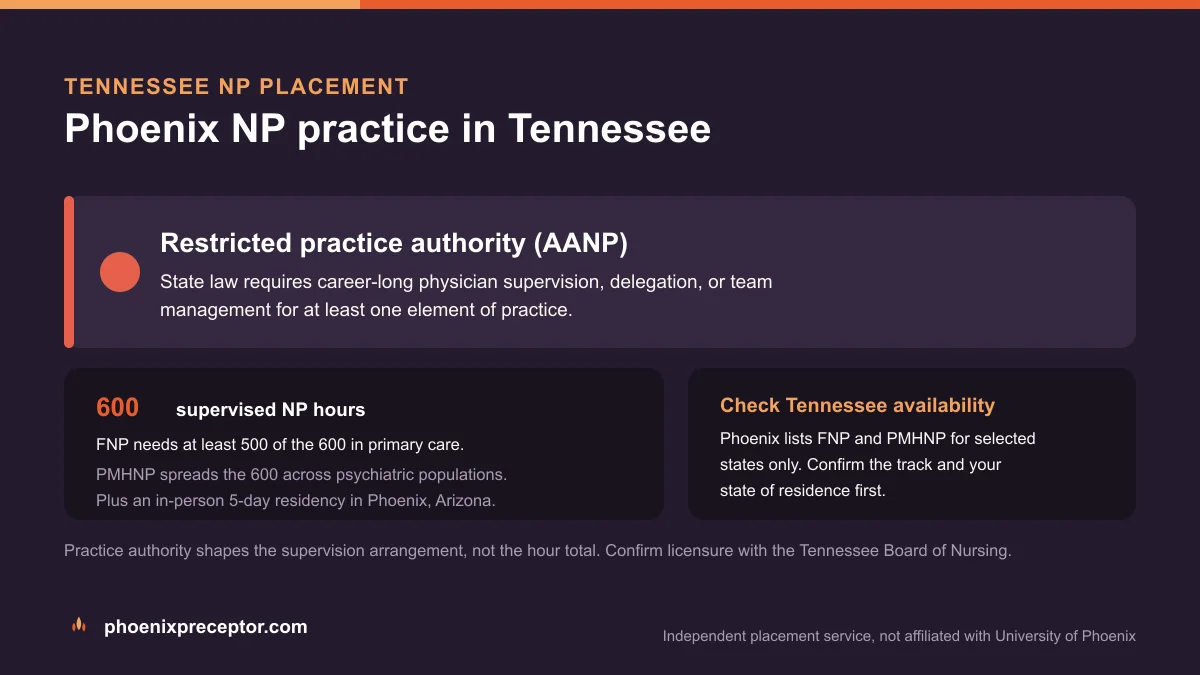
AANP's May 2026 map classifies Tennessee as a restricted practice state. The category means state law restricts at least one element of NP practice and requires supervision, delegation, or team management for the regulated element. A student remains under the approved preceptor and site rules, with no independent authority.
State practice authority affects day-to-day workflow, but it does not decide University of Phoenix eligibility. In Tennessee, keep three decisions separate: whether the online program is available, whether the Board record and practice setting are compliant, and whether the University approves the proposed preceptor and site.
Use the Board record and local Tennessee markets
Use the Tennessee Board of Nursing before treating any referral as a placement candidate. Verify the legal name, active license, advanced practice role, population focus, and any public restrictions. Next, compare those facts with the course objectives, patient population, and University preceptor criteria.
Useful search centers include Nashville, Memphis, Knoxville, Chattanooga, the Tri-Cities, and Clarksville. Tennessee's three grand divisions contain different health systems and drive times, so a student should define a home corridor before expanding the search.
The program-availability gate for Tennessee
Current University program pages and licensure information do not include Tennessee for the online MSN/FNP or online MSN/PMHNP program. Treat that omission as a stop sign for placement outreach. Do not ask a Tennessee clinician or organization to reserve time unless current written University direction says the student's exact program, residence, and clinical state may proceed.
Phoenix nursing programs are approved only in selected states, and clinical hours are generally completed in the state where the student is enrolled as a resident. A different state requires prior Student Appeals approval. For Tennessee, obtain that decision before sourcing, not after a preceptor request has been assembled.
Tennessee: from personal lead to approved Phoenix preceptor
In Tennessee, Phoenix students develop potential leads through personal and professional networks and may review preceptor listings available in Typhon. A candidate is then submitted through a Typhon preceptor request. Clinical coordinator review covers the request, and hours must not start merely because a clinician has said yes informally.
In Tennessee, after approval and the start of clinical work, the student records time in Typhon and the preceptor approves the logs there. Maintain names, dates, site address, license details, population focus, and course information consistent across the request. University and site representatives make approval decisions, and no sourcing service can guarantee a match, approval, hours, or an academic result.
Tennessee: plan FNP and PMHNP requirements without mixing them
In Tennessee, both Phoenix NP tracks require a minimum of 600 supervised clinical hours. FNP students need at least 500 hours in primary care. PMHNP learners need at least 100 hours each in psychotherapy, pediatric or adolescent care, adult care, and geriatric care, plus 200 flexible hours across approved psychiatric populations.
These totals describe the Phoenix curriculum but do not authorize an NP placement in Tennessee. If current written University direction later permits the student's exact circumstances, use the appropriate track distribution to assess capacity. Before then, the 600-hour requirement is planning information, not a reason to contact sites.
In Tennessee, FNP and PMHNP students also attend a required 5-day in-person campus residency in Phoenix during NRP/571. That residency is separate from local clinical shifts and does not change state eligibility. Place travel, site onboarding, employment, and the clinical calendar together before accepting a schedule.
Tennessee: a virtual route is not remote supervision
In Tennessee, the July 2026 handbook permits up to 100 telehealth hours in each NP track, but the student must be physically in the same location as the preceptor. Telehealth describes how the patient encounter occurs. That is not permission for the student to work from one location while the preceptor supervises from another.
We support physical placements and conditional virtual preceptorship routes. For a Tennessee plan, any virtual element still depends on program availability, prior University approval, patient location, the approved site, preceptor credentials, course objectives, and the co-location rule. Confirm the arrangement in writing before relying on it. See virtual preceptorship guidance.
Tennessee: do not apply NP totals to every Phoenix nursing program
Phoenix clinical requirements differ outside the NP tracks. In Tennessee, the RN-to-BSN practicum requires 90 on-site, direct-care hours in community or public health, split 45 and 45 across the designated courses. Acute-care work does not substitute for that community requirement.
The non-NP MSN concentrations each require at least 60 hours. In Tennessee, Administration and Informatics use 15 direct and 45 indirect hours, while Nursing Education uses 60 direct hours. One leader, informatics professional, or educator may be the right preceptor even though that person would not fit an NP clinical course.
In Tennessee, the DNP path works toward at least 1,000 practice hours with an Applied Project. Accepted prior hours may reduce the student's remaining requirement. For Tennessee, DNP students coordinate Typhon records with the Project Chair and External Consultant and use the University's calculation of remaining hours. State availability must be confirmed for each Phoenix program.
When outside sourcing can support a Tennessee plan
Once eligibility is documented, we can review a Tennessee request by program, course, city, patient population, schedule, and physical or conditional virtual preference. We source and screen prospects for University and site review. Students pay only when matched. Pricing is kept on the cost page.
Trusted by nursing students and working nurses. In Tennessee, share the written eligibility context and clinical brief through a free placement review. Our review will identify what can be sourced and what still needs clarification, without promising University approval, completed hours, or a particular outcome.
Good to know
Are Phoenix online NP tracks available in Tennessee?
No. Current University program pages and licensure information do not list Tennessee for online FNP or PMHNP availability. Do not start sourcing unless current written University direction authorizes the student's exact program, residence, and clinical state.
Can Phoenix NP telehealth hours be completed with a remote preceptor?
No. That July 2026 handbook allows up to 100 telehealth hours per NP track, but the student and preceptor must be physically in the same location. Each virtual route also requires current University, site, course, and state approval.
How is a Tennessee preceptor submitted and time approved?
Each student develops leads, submits the preceptor request in Typhon, and waits for clinical coordinator approval before beginning. Throughout the placement, the student logs time in Typhon and the approved preceptor reviews and approves those records.
Keep your comeback on schedule
Tell us your program, your city, and your timeline. We will come back with a placement plan and a realistic path to an approved site and preceptor.
Trusted by nursing students and working nurses.